News
Psychology Students Put New Parental Investment Scale to the Test During Summer SURF Project
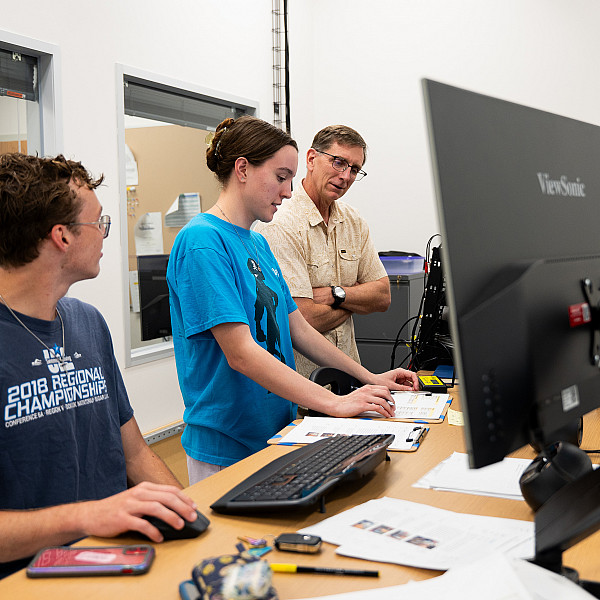
This summer, psychology majors Ingrid Buchwald ’27 and Julia Marshall ’27 worked to validate a parental effort scale developed by Professor of Psychology Carin Perilloux.
August 12, 2026

Open gallery

A team of researchers at Southwestern University are working to help answer an age-old question: how much effort do parents put into raising their children? Psychology majors Ingrid Buchwald ’27 and Julia Marshall ’27 spent their summer testing Professor of Psychology Carin Perilloux’s novel Parental Investment scale, and their results could have broad implications on the study of parenting.
The concept for Perilloux’s Parental Investment scale was originally born out of a 2021 psychology capstone project in which Alyssa Sucrese ’21, Erica Burley ’22, Sarah Woods ’21, and Zach Bencal ’21 set out to study jealousy among married couples who have children.
“Their hypothesis was that people who are married and have kids are going to be more jealous if their spouse makes a new friend, not even a sexual partner, just a friend,” Perilloux said. “If they’re doing a lot of parenting and their partner meets a new person, would that create jealousy? We wanted to throw a parenting effort measure on our study but realized that there isn’t one. That really spawned this whole project.”
Although a few tools exist to measure parental effort, none are designed to provide a quick, reliable, and accessible measure of overall parental effort. So, Perilloux set out to create one. Over the last two years, she worked with psychology capstone students on a series of three studies to build, test, refine, and retest the Parental Investment scale.
“The whole goal of the scale is to come up with a way of measuring individual differences in self-perceived parental effort,” she said. “From our evolutionary perspective, we would expect that the more effort you’re putting into parenting, the less effort you have available for other things, like mating and finding new partners.”
“We focused a lot on brevity, reliability, and accessibility. We’re trying to make it easy for the entire psychology research community to use.” — Julia Marshall ’27
With this new scale created, Perilloux and her team of student researchers submitted their project to the top peer-reviewed journal in the field of evolutionary psychology. The editor came back with a challenge: how does the Parental Investment scale stack up to the other measures available to psychologists?
To help answer this question, Perilloux developed a fourth study, this time a summer Southwestern Undergraduate Research with Faculty (SURF) project. Out of over a dozen student applicants interested in participating in the research, Buchwald and Marshall were selected to assist.
“The editor basically asked us to do this fourth study to make sure that the scale proved incrementally valid and discriminable,” Marshall said. “We’re making sure that it’s better than the available scales that we currently have in psychology. We’re making sure that it’s brief, it’s accessible, and it’s something a lot of people can use.”
One of the first major ways Buchwald, Marshall, and Perilloux validated the Parental Investment scale was to collect real data from real parents. The group employed a leading online survey administration platform called Prolific to collect data from over 500 parents. Respondents had children varying in age from zero to 18 years old and included diverse family dynamics, living arrangements, and even legal custody statuses.

Because the Parental Investment scale is designed to analyze self-perceived parenting effort, the group worked to institute a control for social desirability bias, the tendency of people to present themselves in a favorable light rather than their true feelings and behaviors.
“It was super interesting to see how many people think ‘oh, I’m doing all of these things to the max,’” Buchwald said. “Objectively, you can’t be. There’s no possible way you’re putting in that much effort for all of the things we measure. In all of our models, we control for social desirability. We statistically take out the effect of people who say ‘I’m amazing at everything.’”
Two main drawbacks define the few currently available tools used to measure parental effort. First is accessibility. Many of the tools are proprietary and only licensed to users directly by their creators, a process that can be difficult and time-consuming for psychologists. Second, most of the scales currently available involve a lengthy process to collect data, an element that often increases prices for administrators and frustration for respondents.
“I want to go on and get a Ph.D., and this gave me a little taste of what could be my future. I love to write and do research, so I was having a blast.” — Ingrid Buchwald ’27
The Parental Investment scale addresses both of these issues directly. The group has created the scale using open science, making their research, data, and findings accessible and transparent to anyone. The scale is also considerably shorter than most available tools but without sacrificing the validity of the data.
“The biggest thing is that it’s short and really reliable,” Marshall said. “I think most psychology researchers want to tack on a scale to measure other constructs too. We measured against another scale that had 30 items. Do you want to include that if it’s going to make it more expensive, and more time consuming for participants to take? We focused a lot on brevity, reliability, and accessibility. We’re trying to make it easy for the entire psychology research community to use.”
Throughout the process of validating the Parental Investment scale, the group was able to collect and analyze a treasure trove of data. Not only did their initial data analysis mirror the actions of psychologists who will ultimately use the scale, a worthwhile exercise in determining the validity of the scale, it also revealed interesting trends regarding the perception of parenting.
“I think there’s going to be a lot of predictions related to the scale,” Perilloux said. “We’ve already tested a few cool things. For example, we found that people who perceive that their kids look more like them are perceiving that they’re making more parenting effort.”
The data that Buchwald, Marshall, and Perilloux collected also indicated that parental effort didn’t measurably change depending on how many children the respondents have. Further data analysis revealed that there was no real difference between men and women in their self-perceived parental effort.

“I just think it is so cool that we’re creating something and putting it out in the world,” Buchwald said. “That we can be a part of that process is what drew me in. I know that people will use this and that’s exciting and fun.”
Dating back to the initial conception of the Parental Investment scale in 2021, seven Southwestern students have contributed as authors to the manuscript. Many more have been involved in the studies and have aided in some way, from psychology capstone projects to the former Summer Collaborative Opportunities and Experiences (SCOPE) program, and now to SURF.
“This is why I wanted to be at Southwestern, to do this kind of work with students and show that they can get involved in all these things. We have learned a lot, and every single time, student input has been important,” Perilloux said. “This is very different from what most people in the department are doing, and different from what I normally do. I don’t make scales for a living. I had to read a textbook to figure out how to do this and conduct research to figure out the best way to do it.”
For Perilloux and dozens of other professors across campus, SURF provides the time, funding, and opportunity to pursue in-depth research projects that don’t always fit with the time constraints of the academic year. Southwestern students participating in SURF often conduct research typically only available to graduate-level students at other institutions. For Buchwald and Marshall, who both aim to pursue a Ph.D., this summer’s project was a preview of what could be to come in graduate school.
“For me, this wasn’t necessarily a traditional classroom research environment,” Buchwald said. “This is very much all that we did for six weeks. I want to go on and get a Ph.D., and this gave me a little taste of what could be my future. I love to write and do research, so I was having a blast. Making new connections with professors was so powerful too. I have Dr. Perilloux in a class this fall and we already have a relationship.”
“This is why I wanted to be at Southwestern, to do this kind of work with students and show that they can get involved in all these things.” — Professor of Psychology Carin Perilloux
Despite being a psychology and communication studies double major, Buchwald has yet to take one of Perilloux’s classes. In fact, the two hadn’t even met prior to the beginning of the SURF process. During the SURF Open House, in which faculty mingle with students while outlining their summer research objectives, Buchwald overheard Perilloux describing the project to another student and was instantly hooked.
“You get people who wouldn’t normally apply, or who don’t already know you, or aren’t super boisterous, come up to you and want to pursue these projects,” Perilloux said. “Throughout the years of SURF, and SCOPE before it, I have frequently had students who aren’t psych majors and students that I’ve never met before and I love that part of it.”
To learn more about the Southwestern Undergraduate Research with Faculty program, please visit southwestern.edu/undergraduate-research/surf.
Related Content
Related: