News
SURF in Action: Southwestern Students and Faculty Dive into Summer Research
Now in its second year, the Southwestern Undergraduate Research with Faculty (SURF) program offers students the opportunity to conduct paid, full-time research alongside faculty members.
July 09, 2026

During the summer months, Southwestern University’s lecture halls sit empty, residence halls are vacant, and the usual hustle and bustle is noticeably absent. Although campus is quiet, research, learning, and curiosity continue to reach new heights. Across laboratories, meeting spaces, and workrooms around campus, students and faculty are teaming up to conduct innovative research across a variety of fields.
Now in its second year, the Southwestern Undergraduate Research with Faculty, or SURF, program is giving students the opportunity to advance their knowledge and find new horizons by conducting paid, full-time research alongside faculty members.
In Assistant Professor of Chemistry Sara Massey’s lab, research students are investigating how native environments affect photosynthetic algae’s light-harvesting ability under different environmental stress conditions. Their research aims to increase understanding of how algae’s native environments have influenced their response to stress, and how these organisms survive under unfavorable growth conditions.


Southwestern is one of the nation’s leading liberal arts and sciences institutions for undergraduate research participation and publication. This summer, 70 students have had the opportunity to participate in 21 unique SURF projects spread across 14 disciplines, from researching new HIV drugs and analyzing soils amended with biosolids and effluent to creating a digital archive of Black philosophical and intellectual legacies and investigating the racial history of the University. In many cases, Southwestern undergraduate students are conducting the kinds of research typically only available to graduate-level students at other institutions.
In her “Two Wrongs Don’t Make a Right” SURF project, Professor of Psychology Fay Guarraci and her students are using an animal model to research the effect of antidepressants on sexual dysfunction and anxiety. Their research aims to aid physicians in understanding sexual dysfunction in patients who are prescribed more than one antidepressant.


Guiding principles of the SURF program include constant, ongoing mentored interaction between faculty and students as well as real collaboration and shared ownership of the project. Student participants receive stipends of up to $3,000 as well as housing for most on-campus projects.
Assistant Professor of History Bryan Kauma is hosting “Made in America, Seasoned in Africa,” an examination of culinary transformations and the Americanization of African migrant cuisines. Alongside his research assistants, Kauma is examining the development and transformation of African migrant foodways in America, exploring the historical and contemporary intersections with culture, identity, and power.


Outside of the lab, weekly social events allow SURF students to become members of a tight-knit research community while fostering personal and professional development.
“I love the cohort aspect of SURF,” Chair of the Awards & Honors Committee and Associate Professor of Psychology Carin Perilloux said. “We’re not all in the same building, but we come together at least once a week, sometimes a few times a week, and personally, I love having the camaraderie and sharing what we’re working on in a very low-stakes way.”
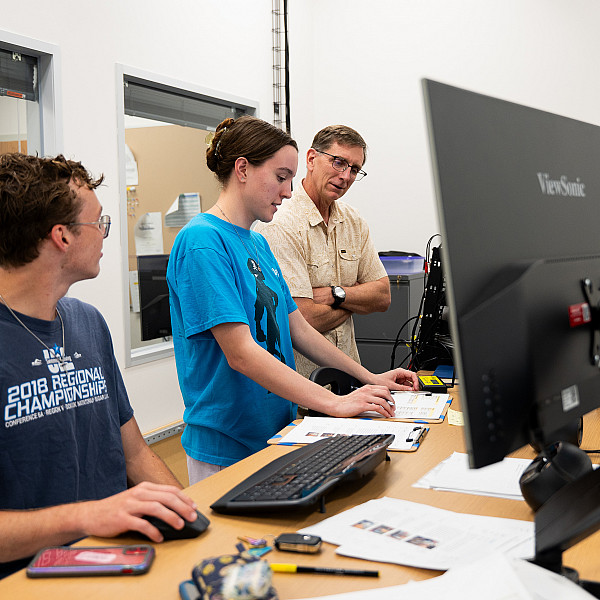
Inside Associate Professor of Computer Science Jacob Schrum’s lab, students are working collaboratively to use modern generative artificial intelligence models to procedurally create content for classic video games. Building on a 2025 summer SURF project, Schrum and his team are working with a variety of open-source large language models to generate images that can breathe new life into retro video games.


Students who participate in SURF have two opportunities to present their work, first at the High-Impact Experiences Celebration in the fall, then again at the Research and Creative Works Symposium in the spring. SURF students and faculty are encouraged to also present their work at academic conferences, with support from Southwestern’s Undergraduate Travel Award (UTA).
“I work to take my research students to conferences to present their research, often at national conferences,” Chief Academic Officer, Dean of the Faculty, and Professor of Kinesiology Scott McLean said. “With support from the University, my students have been able to travel to conferences and see an entirely new side of our field. Most importantly, we have fun working on our projects. The students get to know me on a different level than they see in the classroom.”
Last summer, Associate Professor of German Erika Berroth hosted a SURF project where student collaborators researched “space opera,” a genre of science fiction that focuses on epic adventures set on a galactic scale, in its cultural context. This year, research assistants are continuing the project, further exploring important aspects of fan and readership cultures, the range of advertisements over the years, and the international impact of the series.


To learn more about the Southwestern Undergraduate Research with Faculty program, please visit southwestern.edu/undergraduate-research/surf.
Related Content
Related: