News
From SU to WashU: How Southwestern Sparked Amanda Mejia’s Passion for Aerospace Engineering
As part of Southwestern’s dual degree engineering program partnership with Washington University in St. Louis, Amanda Mejia ’27 will be heading to WashU this fall en route to earning her master’s in aerospace engineering.
June 02, 2026

Open gallery

Amanda Mejia ’27 is halfway through her journey to earn three degrees in six years. After studying applied physics at Southwestern for the last six semesters, she is heading to Washington University in St. Louis this fall as part of SU’s dual degree engineering program partnership with the prestigious midwest institution.
“After talking to my professors about it, and hearing from students who are doing the program now, I realized that it is a really good opportunity,” she said. “WashU is a great school and this program will get me to the place I want to be. This felt like the right next step — studying physics at Southwestern and then engineering at WashU.”
Mejia will spend the next four semesters in WashU’s engineering program, where she will then graduate with dual degrees in applied physics and engineering, the former from Southwestern and the latter from WashU. After that, she has her sights set on WashU’s year-long aerospace engineering master’s program.
“Every little kid wants to be an astronaut,” Mejia said. “I have a picture of me in my fourth grade wax museum where I was dressed up as Sally K. Ride, the first woman in space. I never thought I’d be in a position where I’d want to be a physicist and an engineer like she was. I think it’s cool to call back to that because nothing ever led me there in my mind, but I’m on that path now. Who doesn’t want to build rockets?”
While Mejia is well on her way toward a career in aerospace engineering, that wasn’t always her plan. When she entered Southwestern as a first-year student in 2023, she had her sights set on a biochemistry degree with the goal of pursuing medical school. However, an experience in Assistant Professor of Physics Cody Crosby’s lab had Mejia shifting from biochem to physics with the flip of a switch.
“The summer after my first year, I got into the Crosby Lab,” Mejia recalled. “I did the biochem part, but I saw what they were doing on the other side of the lab in physics. Dr. Crosby recommended that I take [Professor of Physics Steve Alexander’s] electronics course in the fall. Day one of that class, we made a light bulb turn on and my mind was blown. I realized this is what I want to do with my life.”

“Amanda sought to join my bioprinting laboratory at Southwestern toward the conclusion of her first year, but I unfortunately did not have the supporting funds,” Crosby said. “I asked her to attend my lab meetings, and I would then be able to see if I could open a spot the following year. Amanda maintained consistent and active participation in my lab meetings. I later obtained NSF funding to support her role in my laboratory, and she has worked there since. It is one of the best decisions I have made during my six years at Southwestern.”
As she excelled in the classroom and began learning the fundamentals of physics that will ultimately serve as the foundation for her advanced degrees in engineering, Mejia kept thinking back to a passion that spurred her initial desire to pursue medicine.
“I have always wanted to do prosthetics. That was the path that I was on before I discovered engineering,” she said. “Aerospace is something that I really want to go into, but I want to continue exploring prosthetics. I’ve thought about building the facilities behind robotic arms and similar mechanisms for space exploration. Combining the two is something that I really want to do.”
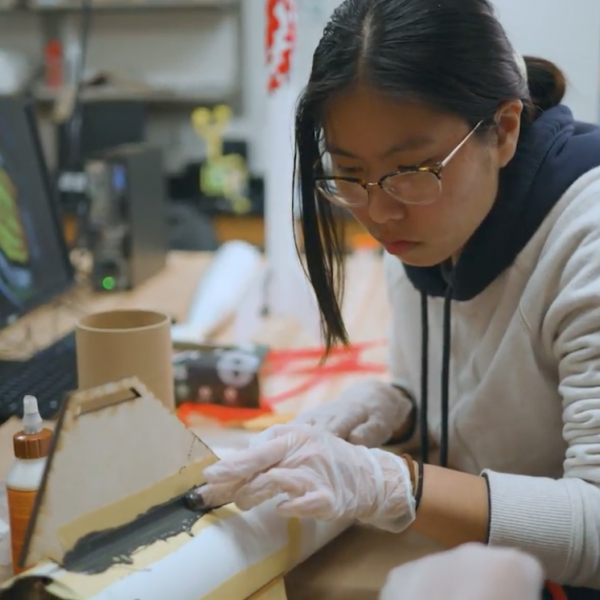
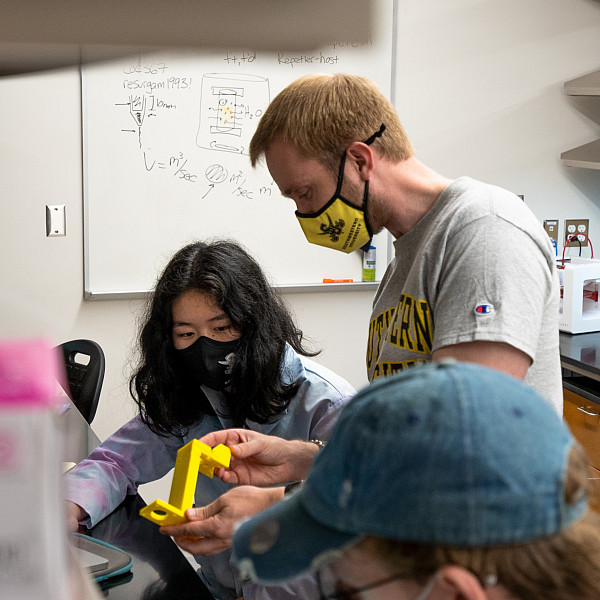
In a Paideia moment truly unique to Southwestern, Mejia had the opportunity to combine her interest in prosthetics with her skill for engineering as part of a 2026 King Creativity project. During a chance encounter with Academic Success Specialist Mary Smith, Mejia learned the story of Speedy the turtle. Smith, who serves as a volunteer at the nearby wildlife rehabilitation center All Things Wild, shared with Mejia that she was caring for Speedy, a 50-pound tortoise who was severely injured after being hit by a car.

What began as a simple skateboard-like device evolved into six iterations of designs that ultimately resulted in a fully 3D printed device that Speedy uses today.
“It was really incredible to approach it because Speedy can’t talk to me. I had to feel the vibes to see if he felt comfortable and could move around,” Mejia said. “There were times he wouldn’t move with a particular device and we had to keep going. By the last design, he fully moved without needing encouragement, and he wore it throughout the day. It was great seeing him use it and understand that it was something that is meant to help him.”
Today, with his newfound mobility, Speedy serves as an animal ambassador for All Things Wild. The tortoise has indicated that he can feel his hind legs, sometimes even trying to move them on his own, an encouraging sign that his paralysis might not be permanent. With this in mind, Mejia designed the device to both aid in mobility and encourage strength and development of Speedy’s damaged legs.
“The idea is that now, while he’s able to use it, it’ll encourage him to use his legs, with the help of the device,” she said. “It’s a crutch, not a wheelchair. By the time he’s older, we hope that he’ll want to move his legs fully and be perfectly okay. Although he’s paralyzed, we believe he can still feel his legs and can possibly get to the point where he can walk normally.”

For Mejia, it was the second year in a row to be honored as a King Scholar. In 2025, she collaborated with Crosby and Joseph Dorsey ’26, who is also participating in SU’s engineering partnership with WashU, on a crowd-pleasing King Creativity project that modified a 3D printer to be able to print liquid chocolate.
The inspiration for the project was born out of Mejia’s previous experience in Crosby’s lab… and a TikTok video. During a 2024 SCOPE project in the Crosby Lab, Mejia created a protocol for using 3D printers to print hydrogels, hydrated polymers that closely resemble human tissue. In his lab, Crosby and his students have been researching and developing techniques to adapt traditional 3D printing technology to be able to print biomaterials in cost-effective ways.
Mejia and Crosby were able to partner with a research group at the University of Oklahoma to use their protocol to affix living cells to hydrogels. Students at OU are currently using Mejia’s research in a Ph.D. thesis.
“That was the first research experience that I ever had and I loved it,” Mejia recalled. “It introduced me to something so incredible. I essentially created a protocol for creating hydrogels and sent that to our collaborators in Oklahoma. We shared our research taking a granular approach so that it would be easier for them to approach it with cells.”

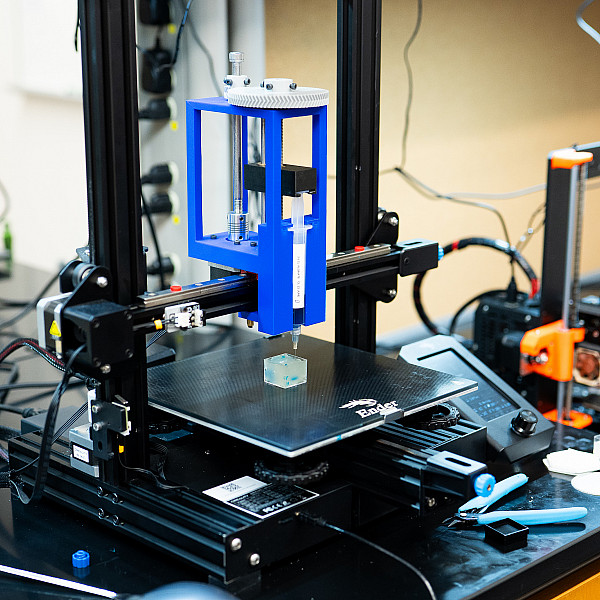
“Bioprinters are really expensive,” she said. “In our project, we built one of these $16,000 printers out of a basic $200 3D printer. We took one of the easiest 3D printers that you can buy and gutted it, keeping only the components that make it move and layer, then rebuilt it with the approach of making it a bioprinter.”
One of the elements that make both bioprinters and chocolate printers prohibitively expensive — a key problem that the Crosby Lab is aiming to solve — is heated extrusion technology that warms up the material to a point where it can pass through the printer effectively. Through their King Creativity project, Mejia and Dorsey were able to use chocolate as a substitute for hydrogels, building a cost-effective, heated extrusion 3D printer.
“Chocolate is really cheap, highly viscous, and comparable enough to a hydrogel that we can use it as a viable material,” Mejia said. “It draws a lot of eyes at conferences because it’s chocolate, but it’s also a heating method that we use that has broader applications to hydrogels.”

Across her various research projects, Mejia has been invited to share her findings and attend events at the 2026 Society for Biomaterials Annual Meeting in Atlanta, the 2025 Biomedical Engineering Society Annual Meeting in San Diego, the 2025 Texas Academy of Science Meeting in Waco, and the 2024 American Association for the Advancement of Science S-STEM Scholars Meeting in Chicago.
“These have been incredible opportunities,” Mejia said. “Because I’m a first-generation student, I have no idea of how college should be. At Southwestern, I know that I have every facility in front of me to help me get to a point where I can go to conferences and talk to Ph.Ds and postdocs and feel like an equal because I’m presenting next to them. I know how to do this, and it’s all because of what SU has been able to show me.”
As a first-generation student from the Dallas suburb of Rockwall, Mejia leaned on several programs at Southwestern to help adjust to college life, including Captain’s Academy, a program that supports first-generation students during their first year, and LatinXcel, a group that fosters belonging, support, mentorship, and opportunities for growth to help participants thrive in college and beyond.

Even before Welcome Week, Mejia began to build a community of support at SU. During the summer before her first year, she joined Southwestern’s EQUIP program, a community for first-year students interested in completing a degree in mathematics or STEM. Short for Enhancing Quantitative Understanding of the Inquiry Process, EQUIP begins during the summer before a student’s first-year with on-campus and online activities that allow students to keep their math and science skills sharp while experiencing the type of work they’ll encounter in college. Students in the EQUIP program are then enrolled in a First-Year Seminar (FYS) together as a cohort.
“EQUIP was essentially the thing that got me in the door here,” Mejia said. “I came in knowing people. I met my roommate and the girls that I lived with and it helped me transition. I knew that I had people who could help me. The next summer, I was an EQUIP mentor. Knowing that I could help other kids in the same way was so rewarding.”
Mejia spent her next two years at Southwestern staying involved with the EQUIP program. During the summers, she would meet with incoming students to help them with homework and provide a first-hand experience of what to expect at SU. She has maintained these relationships and continues to serve as a mentor and a support system for fellow EQUIP students.

“It’s really important to me because I didn’t have people coming to my school telling me about how cool science is and that I can be a scientist. I wasn’t shown that I could be a scientist and I could be an engineer and that I could do all of these things with my life,” Mejia said. “I think it’s really important to teach people this, especially knowing that maybe they come from a background where they don’t experience STEM like this. Nobody in my family is an engineer. Nobody does science like this. It’s cool to be able to show that they could also be the first person in their family to do that.”
In addition to giving back to the community both on campus and around Central Texas, Mejia served as president of the Physics Club, treasurer for the Kappa Delta Chi sorority, and historian for the first-generation honor society Tri-Alpha. She not only maintains her S-STEM scholarship but is also a student member of the Texas Academy of Science and the American Chemical Society.

“Amanda truly embodies the ideal Southwestern student,” Crosby said. “While she was dedicated to her studies and performed well in a rigorous major, she pursued interdisciplinary projects and was highly involved on campus, especially with organizations devoted to representing underrepresented communities. Amanda was an integral part of my research laboratory and always conducted her studies thoroughly and represented us well at international and regional conferences.”
As Mejia transitions to her time at WashU, she has left a permanent mark on Southwestern’s STEM program, not just through her mentorship and guidance of fellow students, but through helping to shape SU’s new engineering major. Mejia was invited to help provide feedback on the new major, giving input on curriculum decisions and the types of courses that she would be interested in taking. Although she won’t get to experience the major herself, she is excited about the possibilities it brings to campus and thankful for the impact that Southwestern has had on her academic journey.
“It’s a really good major. I’m excited that a lot of the first-years and sophomores that I’m friends with are going to get to be Southwestern engineering majors,” she said. “Southwestern has been incredible. I think my life would definitely be 100% different had I gone somewhere else. I wouldn’t be in the position I am now.”
Related Content
Related: