News
Pirate Dining Raises the Bar for Collegiate Hospitality by Embracing Local Options
From produce to packaged products, Pirate Dining’s emphasis on utilizing locally-sourced options highlights Southwestern University’s commitment to sustainability and supporting local businesses.
December 11, 2025

Open gallery

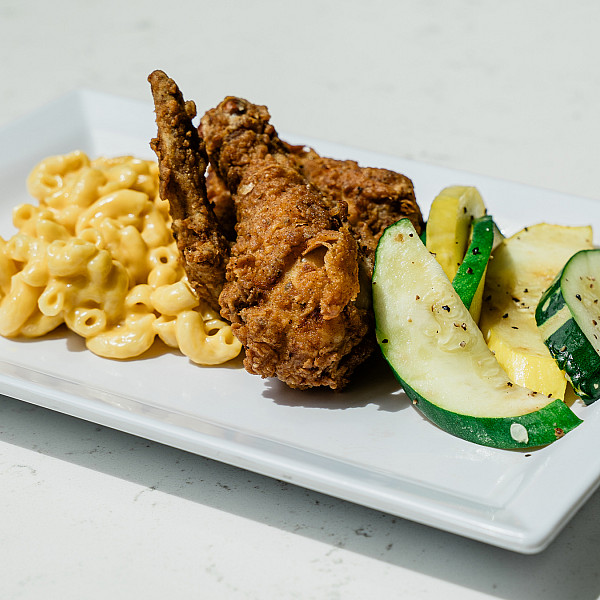
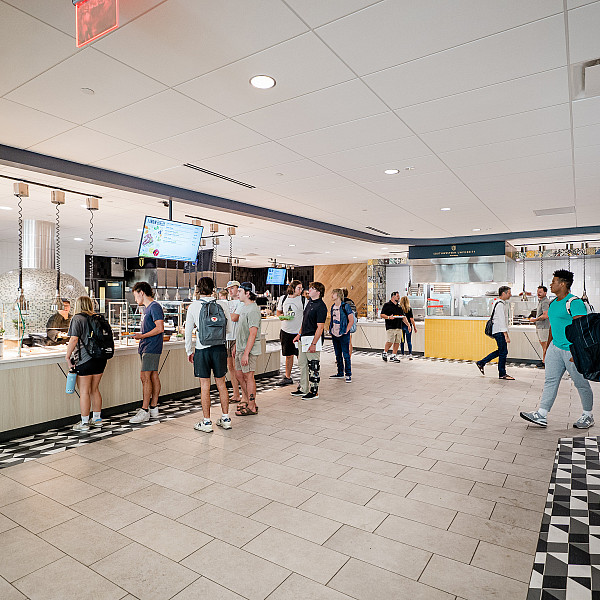
One of Pirate Dining’s newest menu options this year has also been one of its most popular: the Nashville Chicken Salad. Featuring spicy chicken bites served among fresh romaine lettuce, dill pickles, diced cucumbers, and grape tomatoes, topped with croutons and spicy ranch dressing, the Nashville Chicken Salad has become a go-to for hundreds of Southwestern University students, faculty, staff, and other community members who dine at Pirate Dining’s Mabee Commons on-campus restaurant every day.
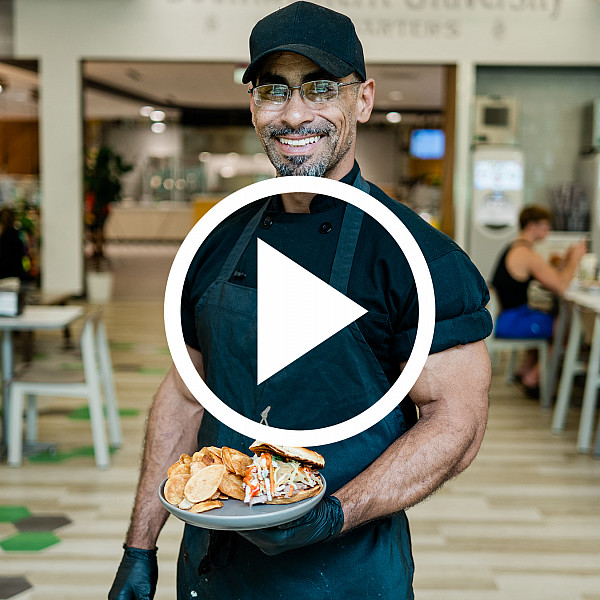
“The number one selling item this semester is by far the Nashville Chicken Salad,” Pirate Dining Executive Chef Daniel Miller II said. “We use hydroponic grown lettuce, both romaine and iceberg. It looks like little squiggly lettuce, but it is a big driving force behind the popularity.”
The success of the Nashville Chicken Salad – and nearly every other item that Pirate Dining serves on its constantly-evolving menu of cutting-edge American entrees, ethnically-inspired meals, vegetarian selections, and much more – can be traced back to one foundational element: fresh, locally-sourced ingredients.

“Our whole team at Lone Star Lettuce wants to be able to provide locally grown, gorgeous products to folks around here, whether at Southwestern or at restaurants and businesses all over Austin and Central Texas,” Massey said. “That’s what gets us up in the morning. We want folks to be able to eat super fresh organic produce.”
What began as a backyard hobby for Massey has evolved into his career. After moving back to his home state of Texas from Chicago when his wife, Assistant Professor of Chemistry Sara Massey, was hired by Southwestern in 2019, Kyle began experimenting with hydroponics in their Central Texas backyard.
Hydroponics is a more sustainable farming method that uses 90% less water than conventional soil farming. In hydroponics, plants grow over water in a recirculating ecosystem where friendly bacteria work to fertilize leafy greens. In a state like Texas, where the climate provides only a narrow window to grow lettuce outdoors, hydroponics can allow for year-round harvesting inside of a climate-controlled greenhouse.
“I started growing lettuce for our family and for our neighbors in our backyard,” Massey said. “Everyone really liked it, and the idea to start a business just kind of sparked. I started calling wholesalers and restaurants to gauge the demand for locally grown, organic produce, and the overwhelming answer was yes.”
Following a decade in corporate finance, Massey quit his job, bought land in Georgetown, built a 12,000-square-foot greenhouse, and officially launched Lone Star Lettuce Growers in 2021. The business provides lettuce, kale, chard, and herbs to Common Market, who distributes the products to restaurants, businesses, organizations, and institutions in and around Austin, Houston, and San Antonio, including Southwestern.

A rarity among hydroponic growers, Lone Star Lettuce Growers is organic certified by the United States Department of Agriculture (USDA), meaning there is nothing on or in his products that isn’t found in nature, an enticing benefit for Pirate Dining.
“Most hydroponics are not organic certified because they use artificial fertilizers,” Massey said. “We’ve found a very unique way through a lot of biology to do this organically, but it’s not common. We want to grow a local, fresh, organic product that hasn’t been touched by chemicals and is serving the community. Typically, the product we ship out is harvested the same day. We start super early when we harvest, so that it is shipped out, and sometimes delivered, the same day.”
The rapid availability of locally-grown products makes all the difference in menu item creation for Chef Daniel and his team.
“With these local options, we are able to provide fresher, more nutritious food,” Miller said. “We locally source the food at peak ripeness, and we get it quickly so that it spends less time in storage and in transit so it retains more of its nutrients and flavors.”
Lettuce isn’t the only product that Pirate Dining sources locally from within the Lone Star State. Through Common Market, Pirate Dining is able to provide fresh turnips, radishes, watermelon, peaches, and pears from Gundermann Acres in Wharton County, just southwest of Houston. Owned and operated by fourth-generation farmer Garrett Gundermann, the 500-acre farm focuses on sustainable agriculture practices.

“We were kind of on the forefront,” Doguet’s Rice Milling Company Vice President Greg Devillier said. “Nobody was really pursuing organic. It was seen as a fad. We started with 25 acres and over the years have slowly increased the amount of acres to where now, we grow anywhere from 5,000 to 10,000 acres of organic crop.”
Having access to certified organic rice not only aligns with Pirate Dining’s emphasis on sustainability, but plays a central role in their offerings at Mabee Commons’ True Balance and Global Kitchen Vegan stations, which provide chef-prepared recipes made without the top nine most common allergens and gluten.
“Organic is better for the environment,” Devillier said. “When you’re spraying chemicals and fertilizers and different things on your plants, you’re killing everything. With organic, we are able to combat weeds and bugs with the way we do rotations and the way that we do our farming practices. It’s about building up the soil.”
Devillier represents the third generation of his family to own and operate Doguet’s Rice Milling Company. He and his mother Debbie are co-owners of the company started by his grandfather, Darby Doguet. The family business provides conventionally and organically grown white rice, brown rice, long grain, medium grain, and jasmine to a variety of wholesalers, food suppliers, ingredient companies, and industrial customers.

Pirate Dining’s emphasis on providing local, sustainable products extends beyond just the meal options at Mabee Commons. The Cove, Southwestern’s campus cafe, features products from nearly a dozen locally-sourced vendors, including Georgetown’s own Lulu’s Pie Shoppe and Jeremiah’s Ice, Austin-based Rambler Sparkling Water, Richards Rainwater, and Celzo, as well as KTonic kombucha from neighboring Hutto.
“We work with some really interesting folks that have the same goals that we do,” Pirate Dining General Manager Greg Hensley said. “We get to see immediately the positive impact that we’re making by providing these products and by our customers buying these products. It’s helping the community. We’re trying to get as many local businesses as we can.”
As additional dining spaces open across campus, including the Lord Cafe within the renovated Mood-Bridwell Hall and the new market within the Dorothy Perry White Welcome Center, Pirate Dining hopes to expand its local offerings. Oftentimes, the idea to carry a product on campus originates from word-of-mouth among students, faculty, and staff. Hensley works with Pirate Dining Marketing Coordinator Deborah Berlanga to conduct research and vet potential vendors.

When Allison Stubbs ’14 opened the first Georgetown location of Jeremiah’s Italian Ice, she never imagined the impact that Pirate Dining and the Southwestern community would have on her small business.
“It’s harder than ever to start a business,” she said. “There’s a lot of big chains and the mom and pop shop is not what it once was. The fact that Southwestern is willing to invest in locally-owned locations means so much. Those dollars make a huge impact on the bottom line of a locally-owned business. That money helps me pay my staff, who are all local Georgetown residents. Those dollars really do stay in the community.”
Inspired by the local snow cone shop that she frequented in hometown of McKinney, Texas, and a renewed desire to help build community following the isolation of the COVID-19 pandemic, Stubbs opened her Jeremiah’s franchise in October 2024. With a desire to give back to her alma mater, she met with Lucy King Brown Chair and Professor of Business Debika Sihi, who helped make the connection with Pirate Dining. Today, pre-packaged, seven-ounce servings of Jeremiah’s Italian Ice are available at The Cove in a variety of flavors.

Pirate Dining’s emphasis on prioritizing the use of local products stems from the organization’s steadfast commitment to sustainability, one that begins at the procurement stage and remains top-of-mind throughout the lifecycle of every product served. To help combat waste, Pirate Dining operates a composting program on campus.
Since the organization began tracking results at the start of the 2024-2025 academic year, Pirate Dining has diverted over 87,000 pounds of waste from local landfills. By composting this waste instead of sending it to a landfill, Pirate Dining is estimated to have saved nearly 60,000 pounds of carbon dioxide greenhouse gases from being released into the atmosphere. That is the equivalent of planting nearly 4,500 trees or removing over 67,000 miles of driving by fuel-burning vehicles.
This emphasis on sustainability has garnered national attention. Pirate Dining recently earned a Silver Award for Sustainable Procurement from the National Association of College & University Food Services (NACUFS). This prestigious honor is awarded annually to higher education food service operations with the best sustainable procurement programs.
“It was nice to be recognized for sustainability,” Hensley said. “This was actually driven by students on our campus, so it was great for the campus to be recognized in this way. We’ve been working toward that for 18-24 months. We started slow and have progressed into what it is now.”

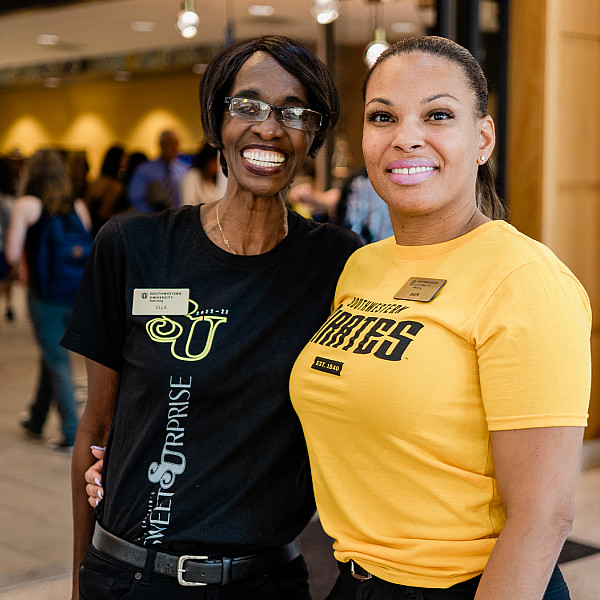
The honor is the latest in a string of prominent recognitions for Pirate Dining. Last summer, the Mabee Commons restoration project earned a Silver Award for Renovation of the Year from NACUFS. Earlier in 2024, Miller earned the “Best Beefy Sandwich” award from FoodService Director magazine. Two of the most visible Pirate Dining employees, Sheri Clayton and Ella Sedwick, were previously honored by the same publication as 2023 Foodservice Heroes.
As Pirate Dining continues to set the standard for collegiate hospitality, their focus remains on providing the best possible experience for Southwestern students, faculty, staff, and members of the wider University community.
“It’s really important to us that everyone knows that we’re all a community here,” Berlanga said. “We’re not just a university dining hall, we’re a restaurant, and we want to continue to pour back into our community.”
Related Content
Related: